Search This Blog

Monday, April 15, 2013

SCP: Containment Breach

Escape a shadowy facility teeming with dangerous monsters

Release: Beta Version (development ongoing)

By Ian Coppock

SCP: Containment Breach has given me an excuse to jump back into the guilty pleasure zone that is indie horror gaming. Quite frankly, the ingenuity that indie developers have put into creating something scary has proven more effective than big-budget horror fests like Dead Space 3, though that one had its moments. This week, I decided to put on the shoes of a reluctant test subject and go play with some less than sociable creatures and objects. SCP: Containment Breach is still in development, though this beta version was certainly unsettling enough.

The Story

SCP (secure, contain, protect): Containment Breach is a game based on the SCP Foundation mythos, a shadowy organization that studies creatures and objects with mysterious powers. You are D-9341, a death row inmate who was spared the electric chair in exchange for a month of work for the Foundation. Though your character was quick to trade certain death for a chance at freedom, he or she knows almost nothing about the SCP Foundation or its... inmates.

The SCP Foundation is full of wondrous and disturbing creatures, most of which have strange powers.
D-9341 is introduced to the Foundation by a parade of masked, tight-lipped guards and scientists. He or she inhabits a small, murky dormitory and must follow any and all orders without question. I began realizing that this place was not much better than prison, and D-9341's fellow test subjects were similarly morose.

Shortly after arriving, D-9341 and two workmates are assigned to conduct tests on SCP-173, a statue that is quite motionless when looked at but instantly strangulates people the second they look away. When a power outage drowns 173's chamber in darkness, D-9341 has just enough time to escape the cell as a larger containment breach shuts down the entire facility, releasing its terrifying contents.


SCP-173 will kill you the second you look away. The statue is one of many monsters D-9341 must elude.
Though SCP-173 can only kill you if you don't look at it, Containment Breach features a blinking mechanic. A surprisingly obvious facet of daily life not often featured in games, D-9341's blinking forces him or her to be more creative than just staring indefinitely at the statue. The game's other major antagonist is SCP-106, a creature that looks like Rupert Murdoch got caught in an oil spill. Unlike 173, 106 can run after the player and phase through solid walls, leading to several highly intense chase sequences throughout the facility.

If SCP-106 grabs you, he hauls you to a "mini-dimension" where you die a slow, horrifying death.
As if D-9341's life wasn't in enough danger, the former inmate must also face several enemies in one-on-one encounters, including a monster that freaks out at you if you look at its face, a sentient coffin that screams at you through facility TV sets, a pair of books that emit deadly bacteria, and a massive reptilian monster immune to all forms of damage. After spending several hours evading monsters and accessing restricted exit areas, 9341 is contacted by SCP-079, an artificial intelligence. 079 offers to let 9341 escape if it can have control over the facility. This and several other choices determine the course of the game and unlock one of three possible endings.

SCP: Containment Breach is terrifying. Between the statue and oily Murdoch, I was having a tough time keeping a consistent pulse. The game is paced in such a way that the danger reappears right as you think it's gone, and the level design is tight and claustrophobic. Most areas are also very dark; 9341 has tools at his or her disposal for navigating the environment, but the atmosphere is blatantly unfriendly. The shadows are thick and the sound is slightly muffled, which made me feel like I was walking underwater. There are a few jump scares but the game really concentrates its horror in the sheer creativity of its creatures, especially the coffin that drives you insane or the books of disease. The sick bastards who made this game state that they plan to add more monsters once the game is completely finished. 9341 is a silent protagonist, so there's not much in the way of character development, but hints are given as to the Foundation's unknown roots and their ultimate goal in harvesting and studying these life-forms.
The Artwork

Yup. You're expected to gallivant into that totally friendly hallway.
Because it's still in development, SCP: Containment Breach's environments are bare and unrefined. The graphics are second-rate and the animations are extremely cut and dry; I mistook my testing partners for crash-test dummies because their animations were so stiff and uncomfortable. But, the graphics' poorness actually added an element of horror to the game for me; with the environment being so bare and foreboding, the facility felt scarier than some of the ridiculously-detailed places I've seen in big-budget games.

Some of the environments reminded me of Portal... at least until the lights went out.
Most of this game's environments consist of tight corridors and wide rooms swathed in thick shadows. Monsters can be lurking in any of these environments, so caution and moving quietly are highly recommended. Some of the environments have shock-white textures, such as the testing chamber up top, but the rest are swathed in murky shadows. The game is not without its Easter eggs and moments of humor. At one point, I was hiding in a bathroom and, ironically enough, nearly wet myself when the toilet behind me began talking. It was some sort of self-proclaimed butt-eating monster, though it didn't move or attack me. The entire episode was so ridiculous that I had to clear the bathroom and keep moving. Peace out, butt-munching toilet.

What I really like about this game is the creativity that went into the monsters. This is a universe where anything is possible; a monster could be a sentient, self-aware book or a scary grabber. They didn't settle for any sort of archetype when making the monsters, going instead with self-aware objects and creatures that had bizarre powers, such as moving when looking away. This was something that I found quite refreshing; too often horror games get trapped in a quagmire of running away from unbeatable enemies. That was certainly the case here, but fleeing didn't just consist of running. It consisted of being extremely careful. I feel like that reflects survival more realistically, but I am a critic, not a drill sergeant.
Should I get it?

Right now, SCP: Containment Breach is a little rough-hewn and not quite finished. If you're up for a visually raw and still scary video game, then I recommend it, but there's no shame in waiting for the finished version to come out... if it ever does. Indie developers are notorious for delays, but the effort put into this project makes me confident that it's in good hands.

Download SCP: Containment Breach

Wednesday, April 3, 2013

Disney shuts down LucasArts, cancels Star Wars 1313

R.I.P.
By Ian Coppock

I found out a few minutes ago that Disney, which now owns the Star Wars franchise, has given the ax to LucasArts, which makes most Star Wars games. They're best known for the Battlefront, Jedi Knight and Knights of the Old Republic series, all of which I love. About 150 game designers are out of work, and the promising-looking Star Wars 1313 game has been cancelled.

What the hell?

It's not exactly a secret that LucasArts hasn't been doing well these last few years, so I can understand if that's the reason Disney shut them down. Regardless of Disney's motive, it's sad to see this veteran game developer go. For how much of a mediocre job Lucasfilm did with the prequel trilogy, the games that LucasArts put out were usually pretty good. Disney has stated that they're restructuring the company and will likely let third-party developers make Star Wars games.

This isn't the end of Star Wars games, but I'm very skeptical that an out-of-house developer will be able to capture the essence of Star Wars as well as LucasArts did. Of course, Star Wars 1313, a gritty third-person shooter and the best-looking Star Wars game in a few years, has also been cancelled. I feel like that game was LucasArt's chance to regain profitability, but we'll never know now. Hopefully this series will jump back onto the saddle sometime soon, but until then, I'm a little depressed. Ug.

Wednesday, March 27, 2013

Bioshock Infinite


Rescue a mysterious girl from a gorgeous, terrifying city in the sky

Release: March 26, 2013 (PlayStation 3, PC, Xbox 360)

By Ian Coppock

Ken Levine, a screenwriter-turned-game designer, has placed himself squarely at the tip of games' ascension into art with Bioshock Infinite. This game is a masterfully-written piece of narrative, with pacing and set pieces to match. If video games are to be taken seriously as artwork, they need to start hosting the arguments of what artwork is and what experiences they hold for the beholder. I can promise you that Bioshock Infinite will not disappoint. It may not amaze or inspire you as it did me, but the game is so beautifully designed that you'd have to try pretty hard not to be drawn in.

The Story

Bioshock Infinite takes place in 1912, and players assume the role of Booker DeWitt, a checkered private investigator. To pay off debts incurred by drinking and gambling, Booker takes a job offered by anonymous individuals to rescue a girl from a city called Columbia. He accepts, and soon finds that the assignment is more than he bargained for. Quite unexpectedly, he arrives to a majestic city floating 15,000 feet above the surface of the earth.

Columbia is one of the most beautiful game environments I've ever seen.
After arriving to Columbia, Booker learns that the city is a sort of ultra-American theocracy run by a president-priest named Zachary Comstock. He also learns that Columbia was built by the American government in 1893, but seceded from the Union following an unspecified diplomatic incident. After meandering through airborne streets and crowds of joyous citizens, Booker finds that the girl he was sent to rescue is being held hostage by Comstock, and has the ability to tear open portals to other dimensions. Comstock tracks Booker and recites, word-for-word, his formerly secret mission and even his thoughts. It becomes apparent that there's more to Columbia than meets the eye. After Booker springs Elizabeth from her jail, the pair must battle fascist civilians, anarchistic rebels, and cybernetic monsters in order to escape the city.

Booker soon realizes that Columbia's citizens are patriotic to an offensive and racist fault.
Like the original Bioshock, which was released in 2007, Bioshock Infinite is incredibly immersive. I was drawn into the game world almost from the first minute of gameplay, to the point where my couch and living room faded away before Columbia's sheer awesomeness. The game is intuitively designed to predict gamers' every exploration impulse. The environment also feels refreshingly organic; citizens gather on picnic blankets to discuss the day's news while shoe-shiners and ice cream salesmen peddle their wares to passerby. As the game progresses, it takes a much darker tone and Columbia's peaceful facade begins to tear away. The journey from light to dark felt completely organic, not that I noticed at the time (I was too busy drooling at the bright colors).

As Bioshock's story becomes heavier, the game's tone darkens without losing any of its beauty.
The game also eschews a considerable amount of character development. Unlike Jack, the silent protagonist of Bioshock, Booker DeWitt is a fully-voiced character, whose own observations and plans provide the guidance for the story. Elizabeth starts out as a childish 20-something who's free after 15 years cooped up in a laboratory, and it's rather amusing to watch her chase butterflies and leave you knocked out on a beach so she can go dance. Booker's rough cynicism clashes heavily with her exhilaration at being free, but the two characters eventually learn to trust and rely upon each other as they face more and more baddies in an increasingly hostile city. Elizabeth never seemed to lose her charm; Ken Levine wrote the character with antics that would ordinarily be annoying but that I thought were uplifting and funny, because I empathized with her having been imprisoned most of her life.

Booker and Elizabeth have to trust each other in order to survive in Columbia.
The gameplay is silky smooth, with effortless transitions between weapons and pseudo messed-up superpowers called Vigors, which give Booker such charming abilities as summoning a crowd of bloodthirsty crows or setting several dudes on fire. Elizabeth can use her tear ability to summon weapons, cover, and other handy dandy items. She can also look after herself and does not need escorting, and thank Christ for that, because nothing breaks immersion faster than having to babysit an NPC. I was free to focus on Booker's own health and well-being, which, in some of the more chaotic fight scenes, was pretty close to all I could handle anyway.

My one major complaint with Bioshock Infinite's story is its somewhat toothless take on philosophy. Bioshock was chock-full of philosophical and historical references, and centered around mankind's right to keep the fruits of his labors to himself. In Bioshock, Andrew Ryan was a bit of a bastard sometimes but he had some legitimate grievances and good philosophical arguments. These made me question which of us was "the bad guy" and added all the more to the story's tension and depth. Infinite's Comstock, while a well-written character, is a racist Christian fundamentalist whose own viewpoints, such as his idea that black people are animals, can be rejected with no challenge whatsoever. Existential philosophy is the heart of Bioshock narratives, and while it was present in Infinite, it was weakened by being so obviously antagonistic.

The Artwork

(slobber)
Bioshock Infinite was built on the Unreal Engine, and features incredibly beautiful scenery. The team at Irrational Games went into overdrive on their time period studies, and the entire city looks, feels, and breathes the American exceptionalism period of 1890-1920. The initial scenes are set with surreal bright lights and fantastic colors, and as the game darkens, the story's tone is further muted with subtle hues.


Bioshock Infinite's open worlds provide breathtaking vistas, especially when surveyed from a skycable.
I also enjoyed Infinite's artwork because it was more than a pretty backdrop. The environments were lively and believable. The floating buildings of Columbia bob in the breeze and gently brush against one another. Cargo trains trundle by, and people look at you funny for checking trashcans for coins. The environment, impossible as it seemed, was made real because the subtle things were accounted for. That was what really made the game immersive.

Beach in the sky? Seems legit.
The artwork is also detailed almost obsessively. Everything is brightly painted and polished, giving the impression that this is a 1912 World's Fair. The game's darker imagery serves as a counterweight by being insidiously somber; the game contains a fair amount of violence and bloodshed, and being a Bioshock game, portions of it are quite disturbing.

Should I get it?

Now that we've moved on from that engagement proposal of a review, we come to the recommendation. I recommend Bioshock Infinite more than any other game I've posted about. This game's story and writing are the apex of good game design, and the artwork will draw you in. It just will. Right now the game's a little pricey at $60, but if you feel like going on a dark but beautiful journey, be my guest.

Thanks for reading! Check back on Tuesday for my review of SCP: Containment Breach.

Tuesday, March 26, 2013

Marriage Equality for All


By Ian Coppock

Today, the Supreme Court begins hearing oral arguments about the constitutionality of denying marriage and other rights to gays and lesbians in the United States. Regardless of your feelings on homosexuality,  the ability to marry the person you love is a fundamental right, not a heterosexual privilege. On the grounds of constitutionality, fairness, compassion and justice, I urge everyone who reads this message to support the fight for equality. I don't like to get political on my blog, so it's a good thing that this is a human issue, not a political one.

In honor of today's historic push for gay rights, I'm posting an article I wrote last summer about how the video game industry is endorsing universal rights by including gay and lesbian characters in their games. I focused on Mass Effect 3 for this article. Please enjoy, and let me know what you think!


It makes me feel good when progressive trends emerge in our nation’s media. It makes me feel even better when those same trends appear in my favorite media: video games. Although it took years, the video game industry has begun to acknowledge the existence of gay and lesbian people. Bioware, a Canadian developer whose titles include the Knights of the Old Republic and Mass Effect series, took up this cause in earnest with Mass Effect 3.

Mass Effect 3, a science fiction shooter with role-playing elements, was released on March 15th for the PC and consoles such as the Playstation 3. In the game, players assume the role of Commander Shepard, a charismatic human soldier who must save the galaxy from an ancient race of machines called the Reapers, who harvest all sentient life every 50,000 years. Players can make their Shepard male or female, and customize countless other features. In Mass Effect 3, Bioware introduced two new characters, Samantha Traynor and Steve Cortez, who are crewmembers aboard Shepard’s ship.


What’s remarkable about these characters is that they mark the first time openly homosexual people have appeared in a mainstream game. Traynor freely discusses her sexual orientation upon meeting Commander Shepard for the first time, and Cortez is grieving the loss of his husband in a recent battle. These characters are each powerful and interesting people in their own right, and adhere to no stereotypes about the gay community. In the futuristic community of Mass Effect, homosexuality is seen as a normal and nonchalant fact of human society, which is exactly how it should be viewed in real life. Players even have the option of romancing Traynor or Cortez. It’s just a game, of course, but even being able to do that is a huge acknowledgement from Bioware that homosexuality is normal, and should be treated with respect.
This heartwarming endorsement from Bioware and Bioware’s parent company, Electronic Arts, is actually a significant victory for the gay community. When a cause gains media visibility, it is an indicator that the people in our society want that cause to be acknowledged. In other words, support for gay equality is growing, and quickly. Social conservatives can point to political agendas and secret gay conspiracies all they want, but the fact remains: Mass Effect 3 included gay characters because enough of the series’ fans asked for them

Media visibility can be used to attain almost anything. President John Kennedy called for an end to racial segregation after seeing images and reading letters from the civil rights movement. Indeed, the Civil Rights Act of 1964 passed one year later after growing support from all corners of society, including the media

We’re seeing the exact same thing happen all around us, right now. President Obama has called for gay equality after seeing the gay community fight for it, and who knows? Perhaps gay marriage and equality will be attained soon. The old Calvin and Hobbes adage of “yell loudly enough and someone will notice” works every time.

The video game industry has chosen to add to the metaphorical “yell”, and I applaud Bioware’s progressivism. The gay community is anything but alone in their fight for equality; the most powerful forms of media have endorsed their right to happiness and a normal life, through not only news coverage, but storytelling. I, for one, am proud of the industry I hope to one day work for. Every quip of dialogue in Mass Effect 3 from Samantha Traynor or Steve Cortez is a message: “We’re here. We’re normal. And gay people can save the galaxy too.”

Thursday, March 21, 2013

3/21 Update

Hey everyone,

Right now I'm finishing up my graduation portfolio. It's important, but it's keeping me away from the desk and the gaming. I apologize for not putting up the Rayman Origins review; next week I'm going to review Bioshock Infinite on the 26th and put up Chris Diller's interview a week from tomorrow. Things have gotten busy, like end-of-college busy, so bear with me for the next week or so. I'd appreciate it :D

Friday, March 15, 2013

How to play really scary games


By Ian Coppock

Before you go any further, I need you to stare at that picture of me. That's my scary game face.


The reason why I had you stare at that picture is because, though I seek out scary games like a drug addict seeks out a broken pharmacy window, I get scared too. Actually, terrified. After Short Horror Week, a bunch of my friends asked me how I could stand playing these games without crapping my pants, to which I immediately responded, "who said I didn't crap my pants"?

The point is that I can play horror games because I have a few tricks for doing so, and so does anyone else. None of us are immune to being terrified, though some of us might enjoy the adrenaline rush. If you're one of those people, or you're looking to get into enjoying the thrill of a scary game, I've taken the liberty of compiling some helpful strategies for doing so. Some of them are a little unconventional, but they helped me feel like I stood a chance against the monster/ghost/mad scientist at the end of the tunnel. Here we go.

Method One: Assume something nasty is around every corner

This is essential to playing any horror game. Scary games are scary because you have limited resources against which to fight a superior foe, so it's essential to pace yourself. Generally, you'll do better in horror games if you progress slowly. Make your character walk slower, and occasionally check behind you to make sure you haven't picked up any stalkers.

Take horror games SLOWLY. There's no point in running loudly around the next corner only to find something waiting for you.
Exploration in a horror game is a double-edged sword. The chance that you'll find an item you need is usually equal, if not less than, the chance of stumbling upon something unfriendly. Therefore, it's critical to assume something nasty is around every corner. Most games have a camera function that will allow you lean or look around corners, which is insanely helpful if you're being hunted by a less-than-amicable person or creature. If you still like to explore, I'd recommend doing so only if your character needs something like a first aid kit or flashlight batteries. Exploring is fun, but in a horror game it can mean death or soiling of the trousers if not done carefully.

Method Two: SNEAK

This is a big one. A monster is only as deadly as its ability to perceive your character. If the horror game you're playing has a stealth or crouch function, use the hell out of it. I've yet to encounter a game where the monster can find you as easily if you're tiptoeing, and I play too many games.

Sneaking is a great way to keep yourself out of unpleasant situations. 
This goes hand-in-hand with taking your time in a horror game. Patience is your greatest weapon for making it through one of these game alive. Explore carefully, walk silently, and use that crouch function. Take all the precautions you can to be as ghostly as the creatures looking for you, at least in the quiet, or um, not being there sense. Don't let your sense of fear or revulsion seize up those running controls, because that's exactly what the game designer (and the monster) want you to do.

In some games, like Slender: The Eight Pages, the monster already knows where you are. The best thing to do in this situation is to remain calm and refrain from whatever activity attracts it, in this case, running. This is another example where patience ultimately wins the day.

Method Three: Get Mad

I'm not kidding. Call me weird, but if I get mad at the monster I'm trying to beat or sneak by, it becomes a lot less scary. I'm no psychologist, but anger can be a great way to make the threat seem less horrific. For example, the only way I got through Slender was by telling Slendy to f*** off every time I saw him. By reducing him to something to yell at instead of something to fear, it became a lot easier to play the game.

At least for me.
SLENDY, GET OUT!! It's not cool to stare at me while I'm in the bathroom, you creeper!!
If this method sounds a little too silly or ridiculous, keep on truckin'. I used it because honestly, I didn't know how else to carry myself through some of these games, scary as they were. But, if you have the audacity to yell and swear at something, you're probably not as scared of it, right?

Method Four: Carry an inanimate object with you so you don't suffer alone

After reading that title, you're probably wondering why I deprave myself of sanity to the point where I pick up an object so I have a little friend against the monsters. If the game's that scary, is it worth playing?

Personally, I'd still say yes. But you're welcome to raise an eyebrow if you so choose. I wouldn't blame you.

Portuguese note!!!! You'll be my friend, right? Right??? RIGHT???? Oh God please be my friend...
One time I was playing a game called Amnesia: The Dark Descent, a game where you descend alone into the monster-infested bowels of a 19th-century castle. Most of the game is extremely dark and unsettling, and it took me a while to work around to playing it, much less progressing. At the beginning of the game, I picked up a wooden crate, named it Bogsworth, and took it with me. It started out as a joke, but I started feeling like having Bogsworth with me meant that my character wasn't suffering alone. Bogsworth was a comforting constant, a port in the monster storm. An object to which I grew attached that gave me comfort in the horrible darkness. A monster might have been after me, but at least I had this box which I'd started to love, who would be there in case I got mangled and left to bleed all over the Prussian tapestry. No one should die alone.

If I get mental hospital people at my doorstep in the next few hours, I won't begrudge any of you for picking up that phone.

Method Five: Take a break

Don't ask me how something this obvious belongs after my crazy-people methods, but it seemed like a nice way to wrap up the article. Sometimes, a game can be just too much. There's a line between being scared and being disturbed, and if you feel like you're starting to cross it, leave your computer and go do something else for a while. Much as I love horror games, they can get quite intense sometimes. If you need a break from the adrenaline and terror rush of avoiding monsters or exploring a scary environment, that's normal. Drink tea, read a book, or create a support system for the scariness. Doing so will make it much more dignified if you start screaming for your mother.

I hope this guide helps, please let me know your own strategies for playing scary games, or if some of my methods just didn't work for you. Also, tell me about your favorite scary games and why you like to get creeped out! Thanks for reading, everyone. I'll see you on Tuesday with another game review :D

Love,

Ian

Post-script: The images in this article came from (in order) Amnesia: The Dark Descent, Dead Space concept artwork, Slender: The Eight Pages, and Pesadelo.

Tuesday, March 12, 2013

Mass Effect


Embark upon an ever-evolving quest to save the galaxy from an ancient threat

Release: November 20, 2007 (Xbox 360, PC)

By Ian Coppock

Lately I've had more time on my hands, which makes no sense considering the impending end of college. But while I just LOVE drowning in a muddy pile of homework and obligations, I took some time off from life last week and decided to play Mass Effect, a game that successfully combines good old-fashioned space adventure with a galaxy full of original ideas. Bioware sticks to what they know, and what they know is how to deliver a mostly excellent story well worth 20 hours or so of gameplay.

The Story

Mass Effect is a science-fiction RPG set almost two centuries in the future, where humanity explores the stars using advanced alien technology discovered on Mars. The game's namesake refers to dark matter, known in-game as Element Zero, which has the ability to increase or decrease an object's mass. This cool little chemical makes it possible for instantaneous space travel through giant slingshot-like devices called Mass Relays. 

Flying into this thing instantly transits you to another location.
The story begins roughly 20 years after humanity made first contact with a colorful alliance of alien races. What's awesome about this game is that you get to create your player character, Commander Shepard, by picking male or female templates and then customizing such features as skin color, face shape, and hairstyle. The resultant badass-in-the-making is your space-saving gunslinger, to whom you can assign a variety of powers and weapon specialties. The game plays like a pretty conventional shooter, with a large palette of weapons and plenty of cover to duck behind. Even if you're not a fan of shooters, the gameplay is simple enough and the story awesome enough for the game to still be worth your time.

The official look of Commander Shepard. Not recommended for people who think women can't fight.
The other cool thing about Mass Effect is that your character can talk, a rarity in games where you make your protagonist. A conversation wheel mechanic is used to make your point to other characters as nicely or rudely as you please. Through this, players can characterize their Shepard to be compassionate or a hardass. Like other Bioware games, your character has something of a morality system, but it's not based on good and evil. It's based mostly on whether you reach out to other alien species or brush past them xenophobe-style.

From top to bottom: friendly, neutral, to-the-point. Or as I like to call it: brown nosing, indifferent, and snarky.
Shepard is also second-in-command on an experimental warship called the Normandy, and assumes control of the ship just in time to embark on a perilous race to save the galaxy from an ancient threat. From there, the plot is heavily inspired by words like epic and grand-scale, though I hesitate to use them sarcastically. The game really does have a tight, interwoven plot, which sees Shepard visiting a variety of worlds all to prevent galactic destruction. There's also an interesting story dynamic in that Shepard works at the behest of both the human military and the combined authority of an alien alliance, whose leaders don't always see eye to eye. This creates a tension and leaves the player wondering whom to be more loyal.

Mass Effect is full of cool alien species, each with their own history, mannerisms, and characters. Some of them get along with humans better than others.

As Shepard, you face off against a rogue military operative named Saren, who commands an army of creepy, flashlight-headed robots called Geth. The story's a little more complicated than that, so rather than spoil it, I'll dance around it like I usually do.

The Normandy, Shepard's ride. This sleek, cloakable ship leaves most competition in the space-dust.

Mass Effect has some nice pacing, and the main plot is supplanted by at least one or two novels' worth of history and stories. Shepard carries a handy dandy codex that you can fill as you go, getting information on everything from Hanar customs to the Quarians' exile from their homeworld. Side missions explore the joys and perils of space life, as well as the sometimes contentious relationship humans share with other species. All of this combines to build a decent narrative that can be as focused or expansive as the player wants.

Shepard also gathers a multiracial squad to help him bring down Saren, and you can build close friendships with them and learn their back stories. One or two are also eligible for a romantic relationship, though this creates that sort of video game guilty-silliness dynamic. Your squadmates also vary wildly, ranging from a petite archaeologist to a grizzled 500-pound bounty hunter.

Shepard can use the Normandy to travel across the Milky Way galaxy, which is necessary for both the main story missions and side quests that see you land planetside in a bouncy buggy-tank called the Mako. Shepard can also scan planets for rare artifacts and archaeological treasures, which I thought was cool, though I wish it was  more than a text window. All of this makes the galaxy actually feel huge; Shepard visits several worlds for the main story and can crash-land on probably two dozen others if he/she so elects.

The Artwork

Mass Effect has some beautiful artwork, with expansive environments and colorful alien species. The galaxy is also studded with vivid planets and bizarre, beautiful landscapes. That being said, the game was released in 2007 and its visuals haven't exactly aged well. The character animations are a little stiff and Shepard seems to suffer a stroke every time he tries to pull a happy or sad facial expression. Shadows sometimes appear distorted and it can take time for environmental textures to load all the way. But, these are minor concerns in the face of the game's sheer visual awesomeness.


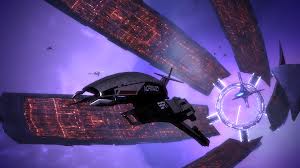
The Citadel, a space city that serves as the heart of galactic civilization, and one of my favorite visuals.
Mass Effect definitely goes for an arty spin on realism, probably to bring out the color and visuals in the alien races Shepard encounters. Some of the planetary environments can get a little monotonous in color, but I was distracted from this by being able to drive across the terrain. The game's musical score reeks of geek, with plenty of synths to pump the atmosphere full of sci-fi awesomeness. The music turns a little more epic for space battles and the like, but this creates a pleasant balance rather than a cognitive dissonance.

Should I get it?

Yes. Mass Effect was one of the highlights of generation seven and received critical acclaim across the board. I echo most of these sentiments, save a few art flaws and story quirks that are mostly irrelevant in the grand scheme of things. You can find a copy of the game for $20 or less, so get cracking! This game is a must-have for any story geeks or shooter fans.