Search This Blog

Tuesday, May 7, 2013

Brink


Fight for the fate of an oceanic metropolis

Release: May 10, 2011 (PC, PlayStation 3, Xbox 360)

By Ian Coppock

Until now I've reviewed games based on the suggestions of others or because I think they deserve attention, the same way an Iraq war veteran who walked into my favorite restaurant the other night deserved (and got) a roaring applause and free food. That all changed over the weekend when a friend of mine told me they were contemplating buying Brink (or BRINK?), a first-person shooter. As a matter of public health and personal safety, I have decided to take screenshots and write this review all to push one sentiment: Brink is the worst game in the entire world, and no one should play it. Ever.

The "Story"

Brink's pathetic excuse for a plot takes place a few decades into the future, when humankind couldn't cease their love affair with global warming and drove the entire planet underwater. The game takes place on the Ark (or ARK? Loading screens used both spellings), a floating metropolis that was built as an experiment in living green, en masse. Though the city fared well enough, it received a flood of immigrants (haha, flood) from the now-submerged nations of the world.

Like many tragedies, Brink begins with an alright premise, which swiftly descends into chaos.
With a population much too large for the cityscape, the Ark's government builds a series of shantytowns to house the refugees. This creates a startling divide between the cozily settled founders, and... everyone else. Brink opens as tensions between both sides rise to a boiling point, threatening an outbreak of war in a once-pristine city.

So far, this isn't so painful, right? In fact, it could be construed as an interesting commentary on immigration, or the struggles mankind will face in the 21st century due to dwindling resources.

Brink could have been a thought-provoking look at how our world might change in the  next few decades.
But no. All of this is encapsulated in a brief three-minute intro video, after which players are asked to side with the Security faction to save the Ark, or with the immigrant Resistance faction to find a way off of it, which seems about as difficult as finding a decent boat.

Why are they fighting for the right to leave the overpopulated city? I guess someone put something in the water.
So wait, why are these factions fighting? The Resistance could just leave and this would make Security's job easier, thus reducing tensions and... oh, don't try to question it.

Though it claims otherwise, Brink consists of about 12 missions, split into 24, I guess, sub-missions? Anyway, each campaign takes place in the same 12 or so maps and just features you fighting for one side or the other. That's pretty much the whole story, and the outcome changes depending on which faction you fight for, making for a pointless story in an equally pointless war.

Again, why is there a war? Security wants to expel the immigrants, and the immigrants want to leave. I'm no detective, but...
There are no named characters and no character development, leaving us completely unattached to either side's cause. Brink's narrative descends into a series of melodramatic five-second cutscenes before each mission. The spoken dialogue is drowned out by the music and sound effects (even with both of those bars toned all the way down in the audio menu), leaving us even less familiar with who these people are or why we should care. Each mission is pretty much the same. You have an item to rub against a door or computer, thus creating success. Also, you shoot things.

Brink's gameplay is extremely repetitive. I got bored about halfway through the second mission.
Normally I don't discuss gameplay unless it has problems, and Brink has more flaws than a gem that's been beaten into pieces and then fed into a blasting furnace. The AI is so broken that it defies description. You have numerous squadmates, but their sole goal in life is to capture these stupid little supply post things, AND NOTHING ELSE. Nothing, not even getting shot at, stops them from running their dumb little hearts out toward the nearest command post and invariably getting killed. This left me alone against a horde of baddies, trying to complete the objective and getting massacred.

"Maybe you can help me complete the mission?" I asked my intrepid commandos.

"No, Ian, that's stupid," they replied as one. "We have to capture the command post so that we can change classes and get extra lunchboxes!"

Your AI buddies live for these stupid things. Without them, Brink might have been at least pseudo-decent.
The gun controls are similarly morose. Each mission is more repetitive than a flight of stairs, and less entertaining. Enemies are so ludicrously numerous that the battle becomes even more unfair.

"But we have to get those command posts," say my squadmates.

And then they all ran off and died like the sheep they were. I got shot because I had no backup, then fell to the floor, only able to yell "run, Forrest, run!" as a conga line of medics got shot on their way to a command post instead of me, and GAAAAAAAAAAAAAAAAAAAAH!!!!!!!! ($%&$()&)(&$#)(!@*%^#*#@$&(#&@(@()!(*#)&#$!!!!!!!!!!!!!!!!!!!!!!!!!!!!!!!!


(huff, puff), okay we're back. I just had an aneurysm but the doctor says that the blood should stop shooting out of my nose soon.

On another note, I found it weird that you could only create and play a male character. I'd expect that from Call of Duty, but the lack of female characters was the cherry atop an icing made from poo.  I refuse to believe that no one on the development team saw Brink as anywhere near ready for publishing, because it wasn't. This game is more broken and dysfunctional than Congress.

The developers didn't even think to put in some slutty female characters to try to bolster sales. That's the oldest trick in the industry!
The Artwork

Before releasing this abomination, developer Splash Damage (as in this game will splash damaging concoctions of anger-inducing chemicals around your brain) toted a sexy, awesome parkour system called SMART. This system would allow players to effortlessly wall-run and jump over obstacles. I'm sure this would have been cool... if there'd actually been any walls or obstacles to jump on. The environments in this game are flat and boring, and riddled with innumerable invisible walls. I played Brink for about six hours and didn't use parkour at all. Perhaps more importantly, I didn't need to use parkour. I even used the skinniest character body type, the other two being normal body type and too-fat-to-be-of-any-use-body type, so there's THAT commentary.

Brink's environments are samey and unremarkable.
Brink's opening cinematic and menus are of reasonable visual quality, but the in-game environments are fuzzy and uninteresting. There's a level that takes place in an abandoned aquarium that reminded me of graphics from the frickin' Dreamcast. Everything is so fuzzy that the game coalesces into what looks like snot that's been dunked into Easter egg coloring kits.

Brink's graphics are sub-mediocre. It looks like a really good original Xbox game.
The worst thing about Brink is that it could have been great. It had an interesting premise and opening storyline, which were the only things that drew me to it in the first place. This all gets lost in bad gameplay that is to good game design what communism was to the Third Reich. The "story" if you can call it that, is murkier than a Scottish peat bog, and even less clear than the in-game visuals. Before you consider it, don't even get this game for something to laugh at with a group of friends. The only brink this game ever brought me to was the brink of beating my TV into a fine powder.

Should I get it?

NOOOOOOOOOOOOOOOOOOOOOOOOOOOOOOOOOOOOOOOOOOOOOOOOOOOOOOOOOOOOOOOOOOOOOOOOOOOOOOOOOOOOOOOOOOOOOOOOOOOOOOOOOOOOOOOOOOOOOOOOOOOOOOOOOOOOOOOOOOOOOOOOOOOOOOOOOOOOOOOOOOOOOOOOOOOOOOOOOOOOOOOOOOOOOOOOOOOOOOOOOOOOOOOOOOOOOOOOOOOOOOOOOOOOOOOOOOOOOOOOOOOOOOOOOOOOOOOOOOOOOOOOOOOOOOOOOOOOOOOOOOOOOOOOOOOOOOOOOOOOOOOOOOOOOOOOOOOOOOOOOOOOOOOOOOOOOOOOOOOOOOOOO

(gaaaaasp)

OOOOOOOOOOOOOOOOOOOOOOOOOOOOOOOOOOOOOOOOOOOOOOOOOOOOOOOOOOOOOOOOOOOOOOOOOOOOOOOOOOOOOOOOOOOOOOOOOOOOOOOOOOOOOOOOOOOOOOOOOOOOOOOOOOOOOOOOOOOOOOOOOOOOOOOOOOOOOOOOOOOOOOOOOOOOO.

Friday, May 3, 2013

White Night


Reclaim your shattered memories from a mysterious psychiatrist

Release: October 12, 2011 (PC)

By Ian Coppock

Asylums are an obvious setting for a horror game. They're naturally unpleasant, involve experimentation on human beings and are created solely for the purpose of confronting psychological pain. However, while I've played countless horror games in which the protagonist must escape from the asylum, this is the first one I've played where my goal is to get further inside. That, as well as decent level design and a ghostly narrative, made White Night my review choice. You guys also seem to love the reviews in which I'm jumping out of my computer chair straight into low orbit, so let's down to business.

The Story

To say that White Night's story is vague is like saying kittens are only slightly cute, but it's not vague in a bad way. There are games with such horrifically skeletal narratives that they hardly deserve the honorific, but White Night's story is different. It encourages players to draw their own conclusions from open-ended events, which I actually kind of like. You are David, a patient at the Denver state mental hospital who has been put into intense treatment for what is implied to be a murder. David wakes up one evening to find the staff gone and the asylum in a state of disrepair. He, that is, you, breaks out of his cell to recall the truth and evade overtly real or imagined threats.

On second thought, I want to go back to my cell.
White Night is a modification, or mod, of Amnesia: The Dark Descent, which is one of the most kickass horror games ever devised by man or dolphin. The mod captures that game's tenseness and atmosphere quite well. It builds up a growing sense of danger through scattered noises, as well as media left behind by staff and patients. David encounters voice recordings left behind by doctors and hidden notes from patients. 

The game's narrative is enhanced rather than interrupted by flashbacks of treatment sessions with a Dr. Sofia, a faceless psychiatrist who attempts to help David remember a past trauma. It's unclear whether she is trying to help or hinder David, or if she's even still alive.  

Dr. Sofia is literally and figuratively swathed in shadows. It's hard to tell whether she's trying to help David or drive him completely insane.
Throughout most of the game, Sofia provokes David by asking probing questions. Why did David commit a crime? Why did he feel the urge to do it? How did he end up here?

The game builds tension worthy of the Cuban Missile Crisis, through the flashbacks with Sofia and through expertly-placed events and visuals. Who threw that chair out the window? Why does that doctor have a TV remote lodged in her spine? What was that thing I just saw running down the hallway?

There's a monster somewhere in this picture. I never got a good look at the damn thing, which made it all the scarier.
As with Amnesia, much of the game is spent advancing through areas slowly and avoiding monsters. Some of the monsters are real while others are imagined. As David delves deeper into the asylum, it's implied that he may have been a staff member at the hospital or related to a patient. His sanity also begins to deteriorate rapidly; I began journeying less through clean white hallways and more through cages floating in an ether of giant eyeballs and snot. There's a reference to Silent Hill in one area.

Is any of this real?
White Night begins to run into a few speedbumps by so completely blurring the lines between real and imagined. I don't mind if a game portrays a journey into that lumpy thing between my ears, but at certain points the narrative threatens to get sucked into itself. There's a confusing bit somewhere in the middle where you have to help the ghost of a self-mutilating murderer retrieve his wedding ring, and I didn't see how that fit into the overall story in ways other than a time-lengthening scheme. That's the danger of writing an open-ended narrative, and it's a worthy risk to take, but some pieces of it were more obviously irrelevant than others. Or were they? GAAH!

For all its horror, White Night encapsulates an absorbing tragedy.
I found White Night to be emotionally endearing in a way that most horror games are not, as ridiculous as that statement may sound. Throughout the story, David's maybe/maybe not transgressions fall away in the face of sheer personal pain. He begins to question every fiber of his being in the face of the game's growing horror. Will he do so until only a shell of a man remains? Will Dr. Sofia help or break his sanity? These questions serve to reinforce the meaning of the phrase White Night, which grows silently as the narrative advances.

The Artwork

Now that I've shed tears over the narrative in a manner befitting a freshman English major, let's move on to artwork. The creator of White Night is to be commended for taking Amnesia, which is set in 1839, and creating an entire set of modern-day visuals. Everything from folding chairs to tiled flooring is custom-made, absorbing Amnesia's gameplay mechanics into a new and visually refreshing setting.

Grime on walls? The sheer amount of detail in the reworked visuals is impressive, to say the least.
A lot of Amnesia mods are sparse in their design, but this game puts all of that to shame. Painstaking attention to detail is made manifest through everything from dirt on cell walls to the placement of chairs, televisions and radiators. The level design is also quite excellent for an indie developer, and matched the pacing. I found myself in large hubs with many rooms that I would have to slowly and painfully explore to reach the next stage of the game. This slow-burn exploration helps make any horror game truly scary.

White Night features many small, richly detailed environments with no easy means of escape or hiding. Perfect for creating a sense of danger.
As with Amnesia, players have no means of self-defense and must run and hide from every threat out there. It's not obvious that certain environments are dangerous until it's too late for an easy exit. I hated at the time but love it as a trying-to-be-informed horror fan. There are certain hell-like sections which reminded me quite a bit of the last third or so of Portal, comprising huge rooms floating in giant orange ethers. The changeups in scenery were a bit jarring at times but overall quite intriguing. 

White Night will grace you with an occasional safe area to mentally relax and recollect yourself before descending into another monster maze.
Perhaps the greatest artistic and atmospheric achievement of White Night is that it makes brightly lit areas scary. I actually clung to shadows in these areas even if there were no monsters. It takes smart design for a starkly lit room to make me yearn for a dark one, and is also probably an indicator that I shouldn't have stayed up until 3 a.m. playing this, but there you go. This game's artwork and level design is worthy of Frictional Games, the creators of the original Amnesia.

Should I get it?

I'm tempted to say that White Night is a good starting place for prospective horror fans. It's still scary but not quite as terrifying as Amnesia. Then again, my friends tell me that I'm desensitized, so instead I recommend this game on the merits of its good design and somewhat jumbled but overall engrossing narrative. The game does, though, suffers from its share of bugs. At one point I was searching under a mattress for any sort of anti-monster substance, and the thing suddenly exploded into a white wall of light and flooded the entire hallway outside. There was another instance where a monster chasing me got stuck in a wall and vanished. But, I digress. If you're looking for a blood-curdling tale of tragedy and fear, and are willing to tolerate the occasional hiccup, then put on some noise-cancelling headphones and download White Night. It's free, so don't use lack of funds as an excuse to stay away.

Tuesday, April 30, 2013

Red Dead Redemption


Hunt down your former outlaws-in-arms at the government's behest

Release: May 18, 2010 (PlayStation 3, Xbox 360)

By Ian Coppock

The gaming world is like school. A frenzied, hard-to-keep-up-with burst of activity throughout the fall and spring lulls into nothingness with the onset of summer. I was planning on buying and reviewing Dead Island: Riptide, but I learned that Techland did absolutely nothing to fix the numerous bugs plaguing the original Dead Island. I don't pay $50 for game developers to give me the finger, so I shall gleefully glide over Riptide in favor of an older but much better game that deserves attention instead: Red Dead Redemption.

The Story

My childhood was plagued with numerous trips to wild west museums so that my dad could memorize every diorama plaque while the rest of us starved to death waiting for him outside. I built up a consequent dislike of anything wild west, so the fact that Red Dead Redemption managed to undo 22 years of hunger-fueled resentment is pretty impressive. The game takes place in 1911 in the fictional state of New Austin, which is Texas in everything but name. You are John Marston, a former outlaw-turned-rancher whose wife and son get kidnapped by the federal government.  They're perfectly happy to give John back his loved ones if he hunts down the vagabonds he used to rob banks and kill innocents with. John puts together a checklist of the checkered rogues he once called friends and skips town to do justice's bidding.

John Marston is one of the most grizzled protagonists I've ever played, in a similarly disheveled portrait of the old west.
John arrives to the hideout of his first target easily enough, and, shockingly, gets shot in the side when his former gun pal says no to the prospect of imprisonment. The easy route thus closed off, John must work with characters of all stripes in a harsh and unforgiving landscape. He teams up first with Bonnie MacFarlane, a charming and tough-as-nails rancher, and Leigh Johnson, the local lawman.

For a while I was under the impression that I'd be working solely with hard-working, law-abiding peeps, but found myself also teaming up with sketchy individuals a la Grand Theft Auto. John befriends and helps out the marshal easily enough, but must also join forces with a demented graverobber, an alcoholic gunrunner and a remarkably pathetic con man.

Nigel West Dickens, the aforementioned con man, was a character I hated because of his excuses but loved because he was so well-written.
Red Dead was developed by Rockstar, who are best known for the Grand Theft Auto series, in which characters usually have a shorter expiration date than three-day-old milk. It's refreshing to see a Rockstar game with such deep and beautifully written characters and dialogue. Though the people John works with are rolling dirty more often than not, their dialogue and mannerisms made them weirdly endearing. I found myself most attached to Irish, a gun dealer who gave me absolutely no reason for attachment whatsoever. Even the dudes I was sent to kill, like the bloodthirsty outlaw Bill Williamson, had personality quirks that I didn't necessarily resonate with but still found immersive for the sake of the plot.

Bonnie MacFarlane is one of my favorite Red Dead characters. Unlike most of the cast, she sees honesty a way of life, not a liability.
Anyway, as these things often go, John finds that hunting down and killing outlaws is no small task, and must expand his grisly reunion party into several other regions. From gunning down outlaws in ghost towns to fighting alongside revolutionaries in Mexico, John takes a varied and quite immersive journey in his quest to reclaim his family. The game also examines the theme that John is a relic of a bygone era, as the old west is becoming rapidly transformed by modernity. What I liked is that most of the characters saw modernity as a scourge; there's a tongue-in-cheek mission where John rides in a car that breaks down and nearly explodes. "Give me a horse any day," he says.

The game pokes fun at the incompatibility of the old west and modern technology. Marshal Johnson tries and fails to learn how to use a telephone, the latest doohickey from back east.
This might be me being jaded about the old west after those museum death marches, but I liked how the game didn't romanticize it. Not once is there a relaxing ride into the sunset. The game portrays the west as it probably was: a savage, brutal and lawless landscape that was anything but poignant. 

There are several stomach-churning missions in which John must stop bloodthirsty outlaws from burning houses and attacking women, all of which reinforced the notion that the old west was not a nice place, to put it lightly. Realism is a difficult line to walk, but this attention to detail and the human condition made the game's atmosphere more believable.

The odds that someone in Red Dead will say hi rather than shoot at you are about 1 in 300.
Gameplay in Red Dead is your typical third-person, health-regenerating, cover-based shooting. The game doesn't really break any new ground in that regard. You can buy guns and health salves, but ammo is ridiculously plentiful and John's health regenerates, so I never needed to visit a shop or make money. This made the game's moneymaking minigames, like bounty hunting and poker, obsolete.

The poker minigame is well-done and quite fun, but money and ammo are so easy to get that it serves no practical purpose.
A massive sticking point this game threw at me was one instance when I saw a would-be rapist attacking a woman outside a saloon. I immediately punched the dude in the face, only for the girl to run away screaming that I'd hurt an innocent bystander. WHAT??? I didn't stop gaping at that spectacle until long after I'd eluded law enforcement and posted bail for the assault charge. It could have all been a bug, but then again, in GTA you can kill hookers with baseball bats, so maybe I'm not cynical enough about Rockstar's attitude towards sexual violence.

The Artwork

Red Dead Redemption is one of the most detailed games I've ever played. It's another nice change of pace for Rockstar, who usually plonk down samey blocks of cityscape in GTA. Getting to my next objective usually meant a half hour or so of fun riding through the desert landscape. Sagebrush sways in the desert breeze, birds roost atop cacti and tumbleweed lazily crosses the horse trails before your feet. 

Red Dead's artwork and lighting are very well done. This is a shot from John's foray into Texan river-rafting.
I can tell you from years of visiting pioneer museums (alright, I'll shut up about that) that the environments are pretty realistic for the time period. John visits bustling train stations, as well as ghost towns, sprawling ranches, and verdant Mexican estates. 

The journey to Mexico was one of my favorite parts of the game, especially visually.
The developers also paid attentive detail to the people. At any moment you can tip John's hat at a passing woman or gracefully sidestep the town drunk stumbling out of the saloon. The environments are detailed pretty much everywhere you go, which helps the game feel big. I'd guess the game's environment is at least 40 square miles, so thank God for trains and horses. The sprawling landscape also reinforces the sense of enormity that comes with John's task.

Later in the game, John visits Blackwater, a bustling city. The variety of environments is surprising, at least to anyone expecting tropes of the old west.
Should I get it?

Red Dead Redemption is not without its flaws and frustrations. Rockstar's always been better with car and horse controls than people, and some of the missions are repetitive, but I think the game's story and visuals should garner forgiveness for these potholes. The dialogue and idioms are true to the times, the voice acting and character development are deep and continuous, and John's journey for redemption is worthy of any high-caliber old west story collection. If any of these things catch your fancy, then go wilder than a warm lizard on a hot rock. 

I read that in a museum.

Friday, April 26, 2013

The portrayal of women in video games


More women than ever are playing games. But the industry risks alienating them through sexualized and demeaning portrayals of female characters.

By Ian Coppock

A few years ago, I took a college course on the portrayal of women and minorities in western media. After a few minutes of discussion, I decided to ask a question I'd never thought of before.

"How many women in here carry pepper spray or knives?"

Almost every girl's hand went up. The revelation blew my mind. I'm a dude, and a tall one at that, so rarely does the question of self-defense occur to me. Beyond that, though, I was a little angry that I'd never born witness to such discussions before. I don't blame women for never bringing it up, though. I blame the media, and our society's staggering inability to discuss female inequality.

Sooner or later, every question I ask applies to video games. I spent a few months conducting my own research into how women are portrayed in video games and gaming magazines, and the results were pretty disappointing. My purpose with this piece is not to evoke a THOU ART SHAMEFUL-esque condemnation of games, but to demonstrate an opportunity that all of us stand to gain from.

How many women and girls play video games?

Want to hear a mind-blowing statistic? According to the Entertainment Software Association, as of 2012, 47% of all video game players are women and girls. When I began the research, I thought the number would be something like 20%, but nope. Nearly half of the national gaming audience is female. There are more 18-and-older women playing games than boys 17 or younger.

What's interesting is that each gender also prefers different genres of games. Generally, men prefer faster-paced and intenser games like Call of Duty or Mass Effect, while women prefer open-world adventure games like World of Warcraft and The Elder Scrolls V: Skyrim.

My research shows that women prefer open-world adventure games to titles like Call of Duty.
There are exceptions to this rule, though. Open-world games are one of my favorite genres, and I know a few girls who love shooters. In the grand scheme of things, though, preferred genres are somewhat irrelevant. The more pressing concern in the video gaming world is how women are portrayed in games.

And how, pray tell, are they portrayed in video games?

I conducted a ton of research on a bunch of different games and gaming magazines from all genres and publishers. I came to a rather disappointing conclusion: I could only find two female characters that were not portrayed in a sexualized or demeaning manner, out of the 150 games or so I have in my apartment. Portrayals in magazines were similarly disappointing: female characters were either portrayed in skimpy clothing or as subservient and shielded by a strong male character.

Case in point: Bioshock Infinite. Note how the female character seems helpless, scared, and almost childlike, cowering behind the male character.

Even if certain games have strong or interesting female characters, they are still demeaned through the outfits designed for them. Some of these characters and costumes are just weird.

Bayonetta, a character from the game of the same name. Would anyone really wear that into battle?
Because it totally makes sense to have ridiculous cleavage armor in combat, right? This is Samara, a character from the Mass Effect series.
I don't... I can't...

The sexualization with Bioshock Infinite's Elizabeth is more subtle. Aside from her obvious cleavage, her eyes have been enlarged to make her seem more helpless and childlike.

Wow. So why are women portrayed this way?

I think part of the issue is that the gaming industry is overwhelmingly male. Designers, composers and programmers are almost always men. The only big-name female game designer I can think of is Jane Jensen, who put out Gray Matter. Some staffs at certain gaming companies, such as Valve, are slowly recruiting more women, but the industry's culture is very masculine. The fewer jobs that are offered to women, the fewer career opportunities will be open for additional women in the future.

Aren't you overreacting a bit? I don't hear female gamers bashing down the industry's doors demanding jobs and better characters.

My counter-point for the people who say that I and female gamers are overreacting and reading into the situation too much is, first of all, to go back and look at the images I posted. Second, consider the following: what do we as gamers and game producers have to lose by improving our portrayals of women in video games and magazines? If you don't believe that strong female characters don't sell, look at Half-Life 2. It's one of the biggest-selling games in history, has a legion of bloodthirsty fanboys, and produced a character who's received dozens of accolades, including a spot on numerous gaming magazines' lists of top 10 characters: Alyx Vance. Alyx is a strongly written character who's not sexualized, and the fans absolutely love her.

Alyx might be the industry's exemplar for strong female characters.
Another example is Mirror's Edge's Faith Connors. Though the story of the game wasn't particularly strong, Faith stands out in my mind as an example of a tough female character. The game sold lotsa copies, by the way. Both of these games disprove the notion that titles with strong female characters can't sell.

Faith can outrun helicopters and beat up legions of SWAT. Mirror's Edge did very well.
So, what do we do?

We reduce the sexualization of female characters. It's a win-win for everyone: female gamers feel more included and represented, and the gaming industry makes more money by including those consumers. They also write better, more immersive stories because the characters are more believable. If you oppose reducing the sexualization of female characters, I guess that's your call, but consider the benefits. Wouldn't you rather have a story with stronger, more realistic characters and stories, especially with how expensive games are these days? I'm sure female gamers would like to feel more included in this wonderful story and artwork world of ours. If you like sexualized characters, that's what porn and creepy fan fiction are for. The gaming industry can do better than this, and I believe reducing the sexualization of female characters will move games ever closer to being widely accepted as art.


Tuesday, April 23, 2013

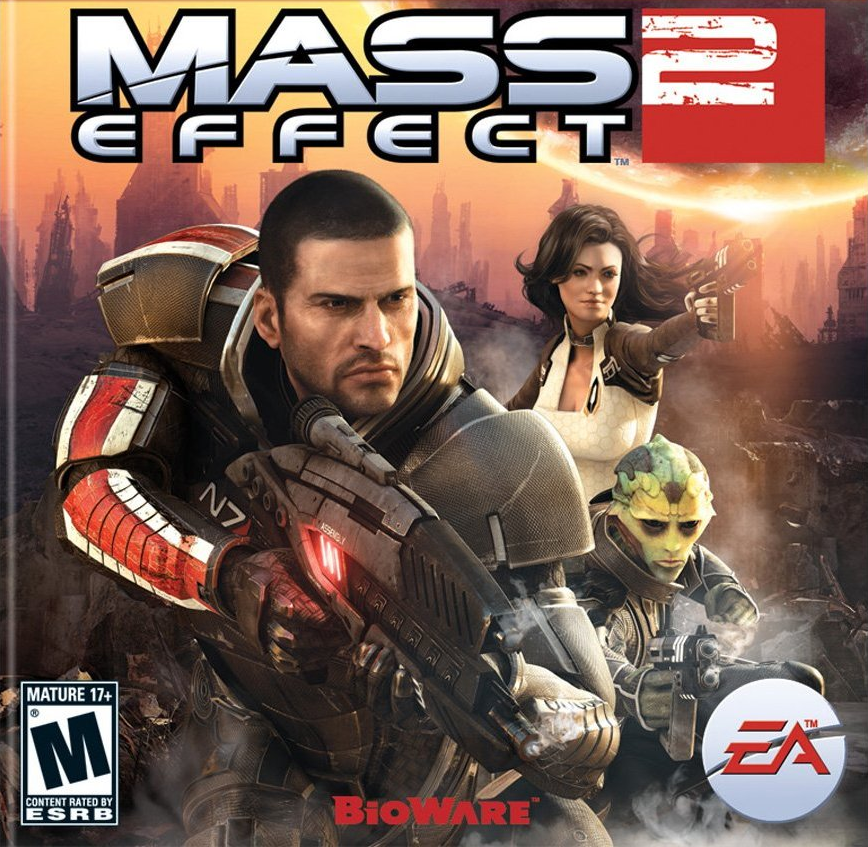
Mass Effect 2


Investigate and stop the harvesting of human space colonies

Release: January 26, 2010 (Windows, Xbox 360)
                January 18, 2011 (PlayStation 3)

By Ian Coppock

Good Lord! That was the hardest headline I've ever written. 

Usually when I'm thinking of an attention-grabbing line, I try to not make it sound generic. When I have trouble coming up with something besides "save mankind from an evil threat" I start to feel like the waters of mainstream gaming are becoming a little too still (high-brow hipster joke). The same can't necessarily be said of Mass Effect 2, thankfully, but I really had to work to come up with that line. In any case, we're back with the second installment of Bioware's most venerable series.

The Story

Like its predecessor, which I reviewed about two months ago, Mass Effect 2 takes place in a sci-fi setting where humans and aliens get around on giant space slingshots called mass relays. Spaceships use a neato substance called eezo that can raise or lower mass with an electric current. 

What's cool about Mass Effect 2 is how literally it takes narrative continuation. Players can transplant their save files from Mass Effect directly into the sequel, thus transferring their own unique Commander Shepard and all the choices made in the first game. Your Shepard retains all the features you picked, from her eyebrows to her preferring dark chocolate over Skittles. The choices you made in Mass Effect carry over to Mass Effect 2 and directly influence the storyline. People you saved from dying in the first game may show up in the second game, and the cool aliens you ran with will either remember your love and friendship or resent you for being a douchebag. But I digress. The point is that this is an amazing little mechanic for making a sequel feel familiar and organic. By transferring the Shepard we've been adventuring with, we're already very connected to the next installment in the story.

Mass Effect 2 lets you transport your Shepard from the first game's save file over to the new one.
Now that I'm done drooling over narrative service, we can move on to the actual tale. Mass Effect 2 takes place two years after Commander Shepard stopped some rather unpleasant fellows from destroying all life as we know it, and sees him or her team up with a pseudo-terrorist organization to save it all again. After an intense and rather heartbreaking prologue, Shepard wakes up on an operating table and is swiftly recruited into a mission to save mankind from giant bugs with guns.

Now we're getting somewhere!

The story is significantly darker than the first installment, which is telltale of setting the stage for an end-all be-all third installment, but Mass Effect 2 is way more than a springboard. The story and dialogue are beautifully written, and unlike the first game, the characters develop significantly as the story goes on.

Mass Effect 2 expands and refines the series' epic beauty.
Shepard falls in with an organization called Cerberus, a survivalist organization that considers the preservation and advancement of humanity a goal without price. They were introduced in a minor way in the first game and are implied to be behind a lot of nefarious business, like assassinations and sabotage, all in the name of mankind's well-being. My Shepard was a little grumpy at the prospect of working with terrorists, but then they gave me a shiny new spaceship, and I kinda left that train of thought.

Cerberus is led by the Illusive Man, an enigmatic glowy-eyed dude who has impeccable taste in space-age formal wear.
One of the new characters central to the plot is the Illusive Man, Cerberus' leader, voiced by and modeled after none other than Martin Sheen. As his name implies, the Illusive Man's identity is a total mystery, but what's not a mystery is his peerless devotion to mankind's advancement. He tells Shepard that entire human space colonies have been vanishing instantly and without warning, and tasks him or her to find the pricks responsible and get the innocent humans back.

I found the Illusive Man to be a fascinating character, because he's one of those people who thinks that the ends justify the means. Little else is revealed, even where he is, but he controls major events from behind the scenes. I had a hard time deciding whether or not I could trust him. This contention makes the story a lot more interesting. It was a hard change from the honor and comfort of Alliance soldiery, but it definitely reinforced the game's dark theme of having no one to trust.

Working for a secret organization rather than the military is kind of badass. I wanted to be a field agent when I was little and now I can live my dream! Sort of.
Shepard soon discovers that a group of insect aliens are behind the abductions, and sets off to recruit a team of badasses for some serious pest control. In stark contrast to the law-abiding and duty-bound squadmates of the first game, most of Shepard's second dream team comprises mad scientists, assassins and outright psychotics. One dude inflicted genocide on an entire race of aliens, and another one was a drug-washed telepath who could punch holes through space stations. A little scary, but for saving the entire human race, I needed the most capable.

(From left to right): Miranda Lawson, Cerberus operative and your right-hand woman, Mordin Solus, a scientist who makes new species one day and headshots the next, and Thane Krios, an assassin who waxes poetic from time to time.
I liked the different aliens and teammates that I picked up from planet to planet, but I wish I could've gotten a little more story out of them. You recruit 9-10 squadmates in total, plus two more with downloadable content, and Bioware only wrote so much conversation material to be spread across that many people. The two bonus characters don't even converse; not really. They just spout trivia at you when you come to visit them.You can also interact with other characters aboard Shepard's ship, the Normandy, and Bioware finally answered my prayers by including a redheaded personal assistant! Woohoo!

Mass Effect 2's story is well-written, but I feel like the emphasis shifted from stopping the big bad bugs to field trips to find new friends. Much of the game is spent recruiting people for your all-star pesticide squad, which is okay, but fighting the insect aliens sort of fell by the wayside. This is reinforced when your squadmates learn that killing the bugs may be a suicide mission, and you have to help them find closure through a long round of missions totally unrelated to the major narrative. 

The other thing that disappointed me is that they took out the exploration mechanic they had in the first game with the Mako buggy tank. You can buy a few bonus missions where you putt around in this kickass speeder-tank thing, but it's not quite the same. I liked driving around in the Mako because it made the galaxy feel big, and Mass Effect 2 feels more like a string of enclosed areas.

Mass Effect 2 has a ton of cool bonus content, if you can spare some extra dough. Luckily, some of it is free, including a few missions with the Mako's successor, the Hammerhead.
I don't want to give you the impression that Mass Effect 2 is bad. Despite some rather glaring narrative pitfalls, the game is a worthy sequel to the original Mass Effect and is also worthy of your time. One of the areas that the sequel improved tremendously from the first game is combat. The cover-based shooting is smooth as asscheeks, and aiming, powers and switching weapons have all been simplified and hammered out from the workable but rather rough combat of Mass Effect. That game's combat was sandpaper to Mass Effect 2's cotton towel. Mmmmm.

The Artwork

Mass Effect 2's graphics remain impressive three years after its release, and the game makes use of bold contrast and stark, strong colors. Facial and body animations have improved dramatically since Mass Effect, and the environments have a lot of added details. The artwork also reinforces the darkness of the game. Shepard's journey from shining soldier to undercover operative is subtly strengthened through the visuals.

Shepard goes from capitols and military bases to seedy space stations and lawless wastelands. Omega, a pirate haven, reinforces Shepard's journey from the halls of power to the fringes of galactic civilization.
Like I mentioned, the facial animations of the characters have gotten a lot better. In the first game, characters had like three different body motions, but they refined that in the sequel, which is nice, because it got weird watching 100 different characters walk away from me in the exact same way. It's like a choreography conspiracy. The sequel also seems to have done away with the long loading times that plagued Mass Effect's environmental textures, and the entire thing looks really polished.

Mass Effect 2's environments are darkly beautiful, in contrast to the stately and brightly lit environments of the original.
I found most of the game's environments to be quite absorbing. It wasn't quite as immersive as, say BioShock (which is an inherently unfair comparison because BioShock is to me what Christ is to a believer), but the level design was competently done, if a bit unimaginative at times. The presence of clusters of cover walls also made it really obvious when a battle was about to go down, so the creepiness of certain creepy areas was sabotaged from the start. Overall, though, Mass Effect 2 is a good game, perhaps even great.

Kelly Chambers. I love you, your red hair and your love of building animal shelters. Everyone's allowed at least one fictional character crush, right?
  
Should I get it?

...I just said it was a good game, didn't I? I give Mass Effect 2 a recommendation on the basis of the material provided, but it's more than just a continuation of the first installment. The narrative stands up on its own, which is something a lot of sequels can't pull off, so this made me love it all the more. The atmosphere and gameplay make it feel different from the first game, but the good, improvement kind of different. Get to Amazon and go crazy. It's been a while since release so you could probably find a copy for $15-20.

Friday, April 19, 2013

Hotline Miami


Massacre hordes of gangsters in a drug-washed, 1980's Miami

Release: October 23, 2012
Platform: Windows

By Ian Coppock

I think it's fair to say that a lot of major developers are afraid to experiment. Some of them certainly have the cash for it, but a lot of mainstream games on consoles and computers alike exhibit a somewhat formulaic approach that improves earning chance at the cost of originality. Get guns, run to cover, point them at baddies, blah de blah. Not so with Hotline Miami, a gory and psychotic top-down shooter that shouts out to the 80's in both appearance and sound. This is one of those great games developed by people who knew that it would be ridiculous. The payoff is a highly original, arcade-esque adventure with pacing and subject matter that would make Hunter S. Thompson proud.

The Story

Hotline Miami's narrative roughly encapsulates April 'till July of 1989. Players take on the role of a nameless hitman who accepts anonymous contracts from messages left on his answering machine. Each assignment is disguised with metaphors like "show the audience a good time tonight" and sees the player off to massacre hordes of enemies with bricks, beer bottles, shotguns, and assault rifles, among other things. Your targets are members of an unknown crime syndicate, presumably an enemy of the player's employer. You also take on police, homeless people, drug addicts and innocent bystanders.

This game is relentless in its violence. I kind of want to report the developers to a psychiatrist.
Hotline Miami is divided into fifteen missions that usually began with me leaving my crummy downtown apartment and ended with me standing in a sea of crushed skulls and bullet-riddled corpses. The game is psychotically violent even by modern standards, and probably would've gotten a tougher rating if not for the stylized, pixelated graphics. Before each mission, the player puts on one of several dozen animal masks that each grant a different power. My personal favorite was Don Juan, a horse mask that made my bashing door attacks lethal instead of 'just' knock enemies out. From there, each level is a top-down maze of rooms in which you must strategically and systematically murder all the occupants. Both you and the enemies die after only one injury, so timing and planning are crucial to a successful massacre. Weapons are strewn throughout the locales the hitman visits, so killing power isn't usually a problem.

It's hinted that some of the game's content is imagined, while the rest is real but possibly jumbled. Confusing much?
It's heavily implied that your guy is into drugs; periodically, you wake up in an alternate reality where your apartment is full of bugs, blood and vomit, and you're interrogated by a panel of anthropomorphic animals led by Richard, a humanoid chicken. Your character also encounters talking corpses and flashes of static before and after the actual missions. It is revealed in the beginning of the game that the hitman's girlfriend was killed recently, implying a motive for his murderous crusades across Miami. Not to worry, though; the hitman rescues a prostitute from a drug den and the two begin a relationship. Your character doesn't speak, unless you consider searing an enemy's face with a frying pan a form of communication, so character development is out the door. It is implied that some of the missions and storyline are presented out of chronological order. 

So basically... this game is what someone sees after mixing steroids with mushrooms. The narrative is soaked in surreal, gory wash and various hints at a larger conspiracy are presented. There's no question, though, that story takes backseat to slamming people's skulls into counters and bisecting henchmen with swords.

The Artwork


Hotline Miami hearkens to 80's-style graphics and presentation. The game is shown in a top-down format, and the entire production is saturated with zany, flashing colors. Rainbows of color and sound explode across the screen during missions, and the game's soundtrack encompasses hazy synths and dance anthem-like tracks. The graphics are heavily pixelated but not the point that all detail is washed out of the production. Certain items and facial expressions are still distinct. Cutscenes feature talking heads with creepy facial features and harsh dialogue, hardening the game's drug-infused edge. 

Hotline Miami's look and feel is awesomely retro. 
I found the presentation appropriate for such a violent game. It would've been much worse had the designers opted for realism. In addition, the game's music is shamelessly 80's in its composition and addiction to synthesizers, which enhanced the retro feeling all the more. The game's environments are brightly colored, and each level exists in a hyperactive ocean of flashing pink and orange. All of this made playing the game a little uncomfortable after the third or fourth consecutive hour, so I wouldn't recommend playing for extended periods of time if you get headaches (or seizures) from ridiculous light patterns.

Color overloads and talking owls? Seems legit.
Should I get it?

Hotline Miami is strangely cathartic. I'm not sure what about a game this violent should be cathartic (nothing that's not worrying, anyway). If you're up for a good old-fashioned arcade mashup of brutal violence and combos, then this game is for you. Ten bucks on Steam. If you're not into ridiculous violence or your tastes have moved past the capacity for retro graphics, then give it a miss.... if you must... but I want more searing frying pan.